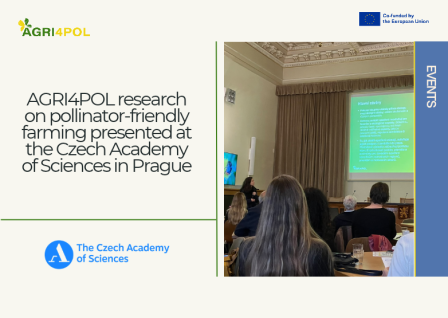
On 15 October 2026, the Institute of Sociology of the Czech Academy of Sciences hosted the conference Future of Food: Sustainable Consumption and Production (Budoucnost potravin: Udržitelná spotřeba a produkce) at the Academy’s building on Národní Street in Prague. The one-day event is part of the Academy’s Strategy AV21 research programme on sustainable food production and consumption. It was organised in four sessions: the transition to more sustainable food systems, local production and self-sufficiency, sustainable consumption and alternative proteins, and food waste.
AGRI4POL partner Tereza Prášilová Chábová from the Global Change Research Institute of the Czech Academy of Sciences (CzechGlobe) presented preliminary AGRI4POL results in the opening session, “Towards more sustainable food systems”. Her talk, given in Czech, was titled “Transformations towards pollinator-friendly agriculture” (Transformace směrem k udržitelnému zemědělství ve prospěch opylovačů). Other speakers in the same session talked about food system transformation in Central and Eastern Europe, farming practices that help soils hold carbon and water, and the role of public catering in sustainable food systems. The AGRI4POL work, co-authored with Simona Zvěřinová and Julia Leventon, comes from the project’s Work package 1.
The presentation covered preliminary findings from focus groups conducted in Czechia, France, Italy, Spain and Switzerland. Bringing together farmers, agricultural advisors, NGOs, researchers and representatives of public authorities, the focus groups explored how different stakeholders perceive the social, agronomic, economic and ecological co-benefits and trade-offs of pollinator-friendly farming practices, as well as the opportunities and challenges associated with their implementation.
Preliminary findings highlighted that willingness to adopt pollinator-friendly farming practices is influenced not only by environmental and financial considerations, but also by often-overlooked factors, such as workload, farmers' reputation and landscape aesthetics. They also pointed to the need for policy support that better reflects regional conditions and stakeholders' priorities.
The CzechGlobe team first presented this work at the World Biodiversity Forum 2026 in Davos in June. The Prague conference was a chance to share it with a Czech-speaking audience working on food systems. Next, the team will analyse relevant policies and carry out in-depth interviews to look more closely at the systemic barriers to pollinator-friendly food systems, and at the opportunities for them.