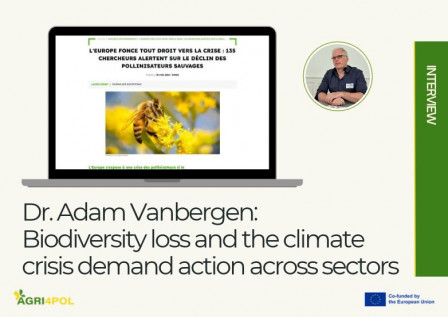
The coordinator of the AGRI4POL project Dr. Adam Vanbergen, gave an interview to the French science magazine Science et Vie regarding the white paper “Towards pollinator stewardship in all policies: Policy incoherence in the EU is a major barrier to pollinator restoration”. The interdisciplinary team of 135 leading Europe-based researchers behind the paper highlighted wild pollinator decline and issued a call to make Pollinator Stewardship an explicit and measurable priority across EU Member States’ policies and sectors.
During his interview, Dr. Adam Vanbergen pointed to the role of pesticides in impacting biodiversity and pollinators in particular, either directly by killing or weakening insects or indirectly by removing wild plants from ecosystems on which pollinators rely for pollen and nectar.
Nonetheless, Adam warns “the combined effects of multiple pressures (e.g. land management practices, pesticides, land-use changes, invasive species and climate changes) represent multiple hits on biodiversity such as insect pollinators (wild bees, butterflies, syrphid flies) and birds”. He continued: “The very nature of this multiplicity of impacts on biodiversity and ecosystems means that in order to be effective, policy responses need to be transversal, cutting across sectors of agriculture, silviculture, industry and nature conservation”.
The cost of inaction is not limited to a single aspect. Dr. Vanbergen underscored the significant economic benefits of supporting pollination for crops such as oilseeds, fruit, nuts and vegetables, but he does not stop there. He also highlights the risk of losing the contribution of pollinator biodiversity to the aesthetic beauty and cultural values of our landscapes, and ultimately to human health and well-being.
The white paper proposes a detailed roadmap of 15 urgent, evidence-informed recommendations for action that, when fully implemented, can reverse pollinator decline in Europe. They can be found here.
The whole interview with Dr. Adam Vanbergen, conducted by the scientific journalist Laurie Henry, can be read in French in Science et Vie here.