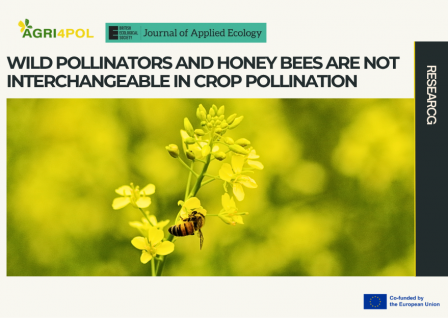
A new AGRI4POL study published in the Journal of Applied Ecology shows that insecticides do more than reduce pollinator activity; they can alter interactions between wild and managed pollinators, changing how pollination translates into crop yield.
Wild pollinators and honey bees are not interchangeable. This is one of the key messages emerging from a two-year field experiment conducted at 35 sites in the Northern Great Plains, USA, using Ethiopian rape (Brassica carinata). Monitoring more than 800 focal plants showed that wild pollinators were more efficient than honey bees, contributing 1.01 seeds per visit compared with 0.79 seeds per visit for honey bees.
In insecticide-treated fields, neonicotinoid exposure disproportionately suppressed wild pollinator activity, while honey bees partially compensated for the reduction in pollination, buffering potential effects on yield. However, wild pollinators consistently contributed more to seed set per visit than honey bees. The study also revealed a non-additive trade-off between the two pollinator groups: higher activity of one group was associated with reduced activity of the other. This trade-off was most apparent in sites without neonicotinoids and became less visible under insecticide exposure because wild pollinator activity was strongly suppressed.
These findings question the assumption that increasing managed honey bee abundance can compensate for the loss of wild pollinators. Honey bees can supplement pollination services and partially buffer the effects of wild pollinator declines, but they cannot simply replace the diversity and ecological functions provided by wild pollinator communities.
The study highlights the importance of moving beyond policies that focus primarily on supporting managed bees. To ensure sustainable pollination services, agricultural policies should combine reduced pesticide pressure, habitat enhancement and the conservation of diverse wild pollinator communities.
As agriculture faces the challenge of maintaining crop production while reducing environmental pressures, pollinator-friendly farming requires more than simply increasing pollinator numbers. It requires maintaining diverse pollinator communities, supporting their complementary contributions to crop pollination, and reducing management pressures that can disrupt functional interactions within these communities.
The study was conducted by Dr Henning Nottebrock, Prof. Dr Alexandra-Maria Klein, Shane Stiles, Dr Jonathan G. Lundgren and Prof. Charles B. Fenster and was co-funded through AGRI4POL.
Read the full publication here.