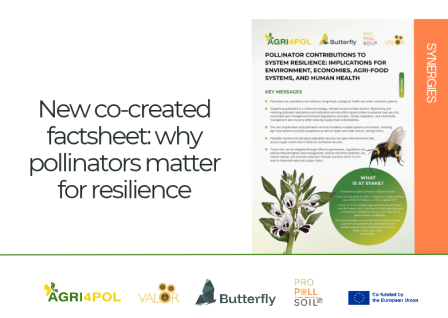
AGRI4POL and other pollinator projects Butterfly, ProPollSoil and VALOR have published a joint factsheet, Pollinator Contributions to Resilience: Implications for Biodiversity, Economies, Agri-food Systems, and Livelihoods. It argues that pollinators should be treated as part of the wider resilience agenda, not only as a biodiversity issue.
Pollination enables reproduction in around 90% of flowering plants. Seventy-five per cent of the leading food crops and 35% of global crop production volume, depend on pollinators to some degree. Yet in many policy systems pollinators are still handled mainly as a nature conservation topic. The factsheet makes the case that they also support food and nutrition security, international trade, human health, land management and climate adaptation. When pollinators decline, the risks spread across all of these systems at once.
The numbers in the factsheet show what is at stake. A 2022 study estimated that inadequate pollination already costs 3–5% of global fruit, vegetable and nut production. That loss is linked to around 427,000 excess deaths a year from reduced consumption of healthy food. In Honduras, Nepal and Nigeria, the value of crop production was 12–31% lower than it would be if pollinators were abundant. Models of a global pollinator collapse go further. They project a 30% rise in crop prices, a global welfare loss of USD 729 billion and an 8% drop in global vitamin A availability.
The factsheet also looks at the difference between wild and managed pollinators. Managed honeybees and bumblebees keep increasing in number, while wild pollinators are declining. Wild bees, flies, butterflies, moths, beetles, birds and bats provide pollination that managed species can’t fully replace. It also sets out how “resilience” is defined by the CBD, IPBES, UNDRR and FAO, so readers working in different policy areas can see where pollinators fit into their own frameworks.
Finally, it suggests practical entry points for action, building on the IPBES assessment on pollinators, pollination and food production:
- aligning biodiversity, climate, land and chemicals commitments
- restoring and connecting pollinator habitats
- reducing pesticide pressure
- taking trade and supply chains into account so pressures aren’t simply shifted to other regions
- including pollinators in agri-food and land-use planning
- creating incentives for the private sector to get involved
The factsheet is based on a review of global assessments and scientific literature on pollination and ecosystem services, including work by IPBES, FAO and other international organisations. A supporting webpage on the AGRI4POL website has the full bibliography and more resilience definitions, which you can find here.
Contributors (listed alphabetically): Holly Barclay, Tom Breeze, ProPollSoil (Paolo Biella, Pilar de la Rúa, Justine Dewaele, Monika Egerer, Georgios Vlontzos, Paul Hallett, Jacek Jachuła, Alex Keller, Georgios Kleftodimos, Sara Diana Leonhardt, Fabio Manfredini, Edward Mitchell, Astrid Neumann, Fabrice Requier, Aleksandra Splitt, Markus Sydenham), Mirella Miettinen, Hien Ngo, Simon Potts, Tereza Prášilová Chábová, Fabiana Spinelli, Tiffany Straza, Adam Vanbergen.
Download the factsheet here.