On 22 July 2026, a webinar was held on the topic of a novel Pollinator-Friendly Farming (PFF) Framework developed within the AGRI4POL project (WP1). Dr Henning Nottebrock from the University of Freiburg presented the first version of the Framework, which aims to assess, map and evaluate pollinator-friendly farming practices across Europe, using Germany as the first case study. The webinar was the first type of presentation of the framework.
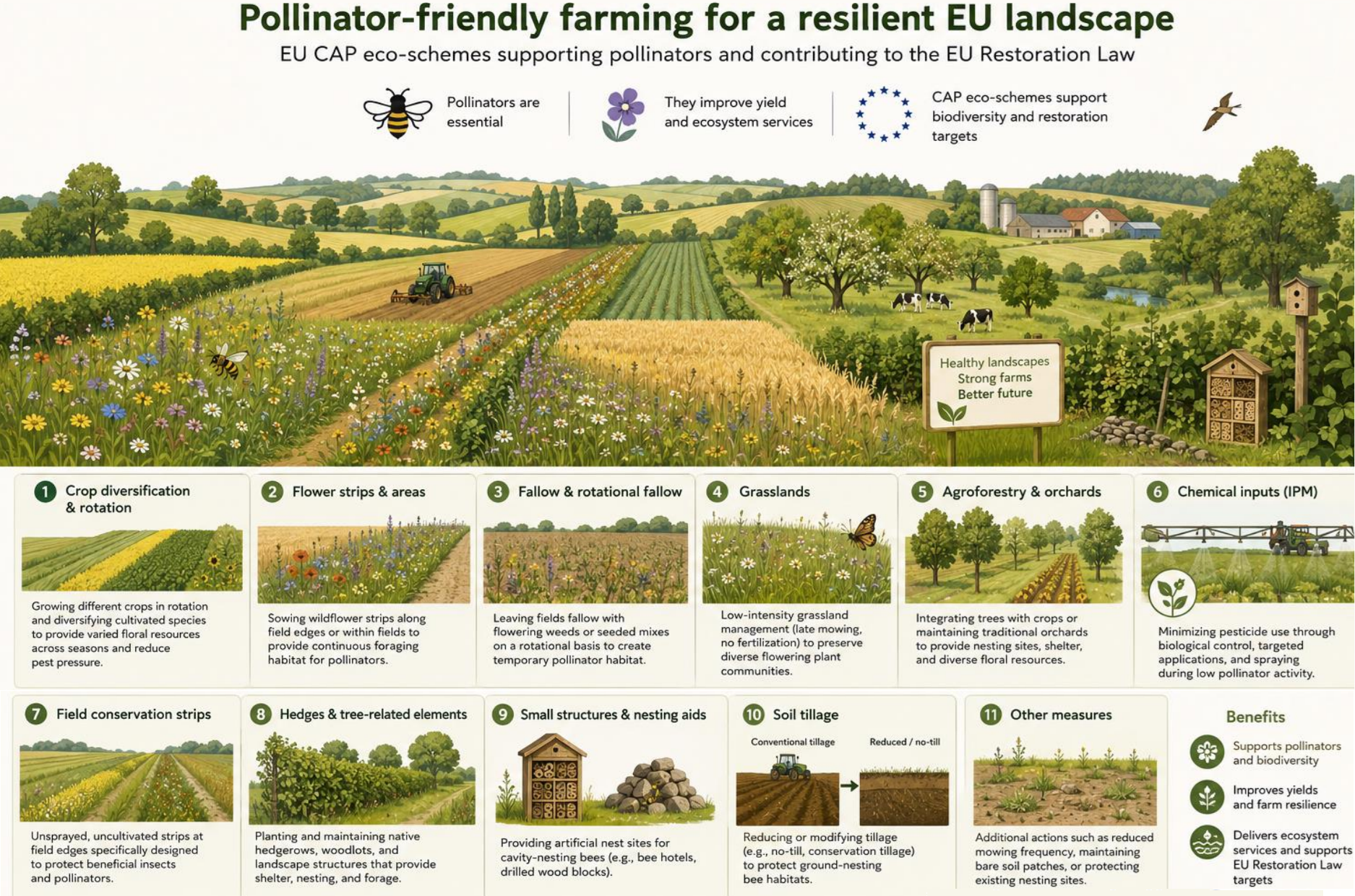
Figure 1 illustrates the ten pollinator-friendly farming (PFF) categories: crop diversification and rotation, flower strips, rotational fallow, low-intensity grasslands, agroforestry, integrated pest management, field margin strips, hedgerows and landscape elements, nesting structures and aids, and soil conservation, plus an additional "other" category.
Applied across field, farm, and landscape scales, the ten pollinator-friendly farming practices enhance floral resources, nesting habitats and landscape connectivity for pollinators. The framework demonstrates how combining these measures supports biodiversity conservation, sustainable agriculture, and the implementation of the EU Nature Restoration Regulation through a multi-scale, socio-ecological approach.
The framework also combines ecological, agricultural, climatic and social data into a socio-ecological modelling approach to support research, policy and practical decision-making. A key innovation of the framework is the integration of social survey data with environmental variables, linking farmer acceptance of pollinator-friendly farming practices to:
- Landscape metrics derived from the pollinator-friendly landscape map
- Climate variables from the CHELSA bioclimatic dataset
- Postal-code-level survey data on farmers' acceptance to implement pollinator-friendly farming practices
This enables the development of statistical models that explain how environmental conditions and landscape context influence farmers' acceptance of pollinator-friendly management.
The German case study demonstrates that combining environmental information with farmer survey data provides valuable insights into the adoption of pollinator-friendly farming. Initial analyses suggest that farmers may increasingly view pollinator-friendly practices as a form of climate insurance, helping reduce production risks under increasing climatic and environmental uncertainty. ‘Farmers see the investment in pollinator-friendly farming as an investment in the future, a way to buffer thе uncertainty’, concluded Dr Henning Nottebrock.
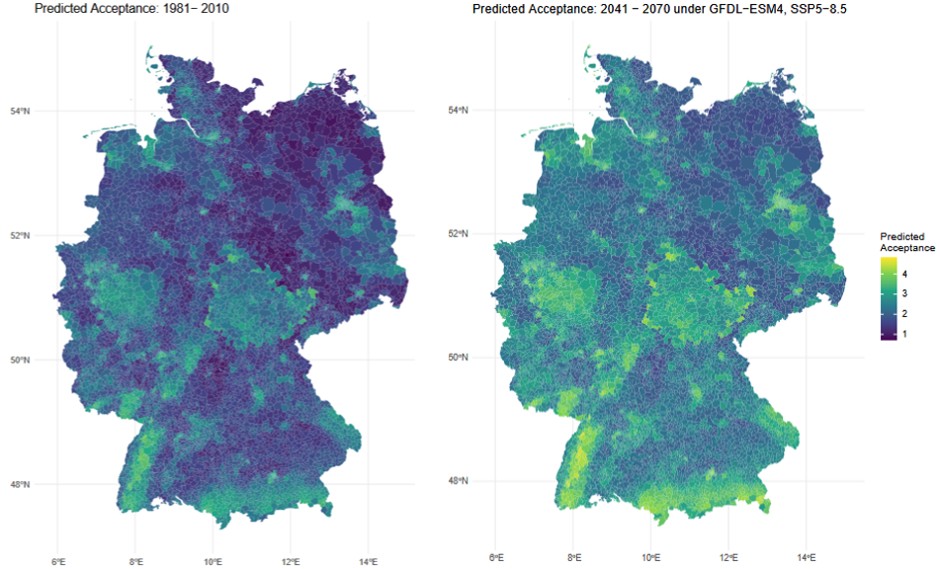
Figure 2 presents predictions of PFF acceptance under current and future climate and land-use change scenarios for Germany. These projections, derived from the socio-ecological model, show how stakeholder willingness to adopt PFFs may shift under future environmental conditions. The map identifies regions where acceptance is expected to remain stable, increase or decline, providing a forward-looking basis for targeted policy interventions and co-design processes. This future-proofing dimension is essential for designing anticipatory restoration strategies under the NRR.
The framework is designed to be transferable across Europe and will be implemented together with AGRI4POL partners in additional case-study regions. Beyond scientific research, the framework provides a scalable decision-support tool for researchers, policymakers and stakeholders to identify priority areas for sustainable agriculture, biodiversity conservation, and ecological restoration under the EU Nature Restoration Law (NRR). It also provides a standardised methodology for monitoring pollinator-friendly landscapes across Europe.